The Case for a Single, Distributed Database Under Growing Infrastructure Constraints

Boaz Palgi
CEO and Co-Founder



Boaz Palgi
CEO and Co-Founder
TL;DR - RegattaDB runs four applications on the hardware you'd normally use for one, without pipelines, without extra licenses, and without replacing what you already have.
Databases typically do one thing well. Transactional systems handle writes and live state. Analytical systems handle queries and historical data. Vector stores handle semantic search. Each is purpose-built, which means every application that needs more than one capability ends up running more than one system, with its own compute, storage, pipelines, and operational overhead.
RegattaDB runs transactional, analytical, and vector workloads in a single engine, against the same data, at the same time. Applications no longer need a stack of systems to function. Data is not duplicated, compute is shared, and license costs collapse across the board.
That unification is also what makes the platform possible. Because RegattaDB serves all three workload types from one layer, many applications can share a single cluster rather than each provisioning their own. Organizations run more on the same hardware, without fragmented per-application stacks.
An executive mandate not to buy more servers, combined with real data center power and cooling constraints, makes a platform that runs 4x more applications on the same footprint a fundamentally different conversation.
Enterprise data centers are sized for traditional workloads but now need to meet the demands of AI workloads they were never designed for. Power availability and cooling capacity have become genuine constraints, not theoretical. Hyperscalers are working through multi-year queues for power permits. Enterprise infrastructure teams are fielding executive mandates to expand AI capacity without expanding the physical footprint.
At the same time, the arrival of AI has materially changed the cost conversation inside IT budgets. Teams that managed predictable server and storage spend now need to absorb new categories of cost with nothing offsetting them elsewhere in the budget.
In the past year, supply chain challenges have more than doubled the costs of DRAM memory and NAND flash storage, with no relief in sight. Capital budgets are under pressure. The directive to do more with what you have is no longer a cost-reduction posture. It is a structural reality for most enterprise infrastructure organizations.
RegattaDB consolidates three categories of infrastructure into one and eliminates the pipeline and replication overhead that fragmented stacks require. The result is a single shared platform that runs more applications on the same hardware. Applications share the platform rather than each owning a copy of the infrastructure.
This changes the economic model. Instead of provisioning three systems for every application, organizations provision one platform for all of them. Compute and storage are shared across applications rather than duplicated for each. A new application added to the platform costs a fraction of what it would cost to stand up its own stack.
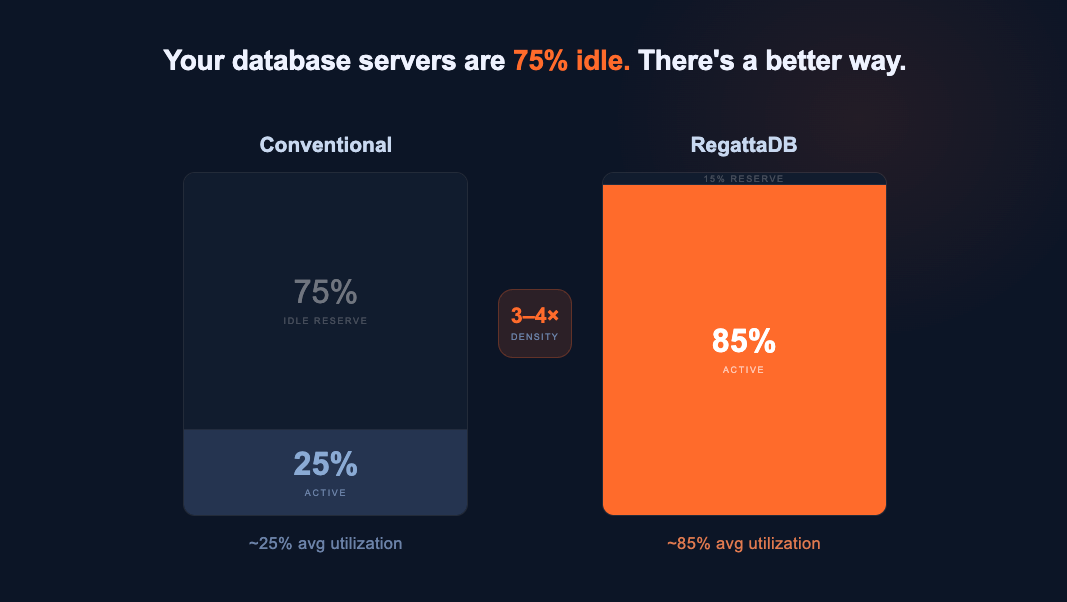
Database servers in production environments are routinely provisioned well above their sustained utilization, often running at 20-40% of capacity on average to maintain headroom for traffic spikes, batch jobs, and unplanned load. That buffer is necessary but expensive, and given that traditional databases are confined to the borders of a single server, it is isolated per server. RegattaDB requires only 5-15% reserve capacity, leaving 85% available for active workloads. This difference compounds across a cluster.
Because peak buffer resources are shared across the cluster rather than reserved per node, RegattaDB requires significantly less overprovisioning per server. The result is 3–4x higher workload density and 300–400% better hardware utilization than a conventional per-server architecture. Where 40 conventional database servers are needed to run a given set of applications, a 10-node RegattaDB cluster handles the same workload with headroom to spare and can absorb the peak demands of multiple applications simultaneously without contention.
| Conventional (40 nodes) | RegattaDB (10 nodes) | |
| Typical peak reserve per node | ~75% | ~15% |
| Sustained utilization per node | ~25% | ~85% |
| Application workloads per node | 1x | 3x |
Conventional figures reflect a common production configuration where servers are provisioned for isolated peak demand. Actual utilization varies by workload and environment.
In the above, each RegattaDB node runs the equivalent of 3x the application workload of a conventional node, with 10% additional headroom remaining. Across the cluster, 600% aggregate peak buffer is available which is sufficient to absorb about 12 applications each spiking 50% at exactly the same time.
Result: 3–4× more applications on the same hardware, or the same applications on 75% fewer servers.
Savings accumulate across every application that runs on RegattaDB. License costs fall when one contract replaces separate agreements across database, warehouse, vector, and integration vendors. Infrastructure costs fall when shared compute and a single storage footprint replace independent clusters multiplied across every application in the portfolio. Operational costs fall when one platform replaces the effort of maintaining pipelines, resolving data lag, and governing security across a different stack for each application. Cost growth becomes more predictable as each new application adds cost at the margin rather than from scratch.
RegattaDB runs OLTP (live transactions), OLAP (real-time analytics), and Vector (semantic reason) in a single storage layer with shared compute, built from the concurrency model up to handle all three without contention. Not stitched together. Not separately replicated. One platform, shared across every application, with one consistent view of the data underneath all of them.
Infrastructure constraints in the modern data center are real. Power, cooling, and hardware availability will continue to shape what AI deployments are financially viable. Organizations that standardize on a platform that does more with the same hardware, without per-application sprawl, will find themselves with room to grow when their competitors are running out of it. That is the decision RegattaDB puts on the table.

TL;DR Agentic AI workloads often push row size and update volume into this territory as a matter of course. That's...

In January, OpenAI engineer Bohan Zhang published "Scaling PostgreSQL to power 800 million ChatGPT users". It is excellent engineering. A single...

Our CTO, Erez Webman, recently published "When Rows Outgrow the Page: RegattaDB vs. PostgreSQL TOAST," and it has...